
9 Essential Gilded Age Dramas To Watch
How The French Celebrate Valentine's Day
370 Year Old Spanish Cross Found At Maryland Archaeological Site
Surprising Ways Victorians Flirted

No haggis here, but there may be a wee dram later!
O my Luve is like a red, red rose
That’s newly sprung in June;
O my Luve is like the melody
That’s sweetly played in tune.
So fair art thou, my bonnie lass,
So deep in luve am I;
And I will luve thee still, my dear,
Till a’ the seas gang dry.
Till a’ the seas gang dry, my dear,
And the rocks melt wi’ the sun;
I will love thee still, my dear,
While the sands o’ life shall run.
And fare thee weel, my only luve!
And fare thee weel awhile!
And I will come again, my luve,Though it were ten thousand mile.

When I started writing Violet’s story, I was so excited to combine two of my old passionate interests into one book—the history of the British royal family, and nineteenth century Russia! I also got to bring in another interest of mine, which might not really seem to fit into the 1870s—1930s screwball comedies! I love it when strait-laced Cary Grant begins to enjoy life thanks to Katherine Hepburn or Irene Dunn, learning to have fun at last. I also got to learn something quite new to me, Victorian photography.
Much like Prince Charles and Lady Diana in the 1980s, Prince Alfred (second son of Queen Victoria, a career naval officer) and Grand Duchess Marie, only daughter of Tsar Alexander II (who had many, many sons!) was the wedding of the year. They met in 1868, but neither family approved of the match, and they didn’t marry until January1874. It was a very lavish wedding at the Winter Palace, an Orthodox ceremony followed by an Anglican blessing, then a banquet for 700 and ball for 3000 until the early hours of the morning. It was the sensation of the newspapers, with a Who Is Who guest list of people like the Prince and Princess of Wales, Princess Royal Vicky and her husband, Prince Arthur, and the elderly Ernst, Duke of Saxe-Coburg (who had no legitimate children so Alfred eventually was his heir). (For more wedding details, I love the sadly now defunct blog, Order of Sartorial Splendor, whose archives are a gold mine!).

(One quick note on the photographic exhibit Violet visits—it’s based on a famous display in 1864, a “Bazaaar for the benefit of female artists” at the Horticultural Gardens at Chiswick. The photographers Julia Cameron, Clementina Hawarden, Lewis Carroll, and Oscar Rejlander are of course real figures, as are the royal family.)
If you’re curious about the time period, I loved these sources for further study! And visit me at ammandamccabe.com for more info!
Photography
Todd Gustavson, Camera: A History of Photography (2009)
Alma Davenport, The History of Photography: An Overview (1991)
Bruce Bernard, Photo Discovery: Masterworks of Photography 1840-1940 (1980)
Victoria Olson, From Life: Julia Margaret Cameron (2003)
Victorian Giants: The Birth of Photography (exhibition catalog)
BEC Howarth-Loomes, Victorian Photography (1974)
Royalty
Daphne Bennett, Queen Victoria’s Children (1980)
John Van Der Kiste, Alfred: Queen Victoria’s Second Son (2013)
Julia Baird, Victoria the Queen (2016)
Adrian Tinniswood, Behind the Throne: A Domestic History of the British Royal Household (2018)
Daphne Bernard, Vicky: Princess Royal of England and German Empress (1971)
Jane Ridley, The Heir Apparent: A Life of Edward VII (2013)
Marie, Queen of Romania, The Story of My Life (reprint 2019)
Richard Hough, Edward and Alexandra
Russia
Stefano Papi, Jewels of the Romanovs (2010)
Mathilde Kschenssinskaya, Dancing in Petersburg (1961)
The Last Grand Duchess: Memoirs of Grand Duchess Olga (1964)
Russia: Art, Royalty, and the Romanovs
Susan McCaffray, The Winter Palace (2018)
A little late in the weekend, but better late than never!!! I hope you all had a lovely holiday season. I've finally put the decorations away, and am digging out to try and concentrate on writing the new book. In the meantime, here are a few fun reads I've come across lately...
Legendary Nights With The Bright Young Things
The Duchess of Cambridge Turns 40!
Everyone Is Dressing Like A Bookstore Regular
The Great Sidney Poitier Passed Away
The Last Letter Of Mary Queen Of Scots
Walt Disney Borrowed From 18th Century France For Princess Culture
When Montmartre Was Harlem On The Seine
An Intimate Glimpse Of Frida Kahlo's Blue House
Santa Fe's La Fonda On The Plaza Turns 100 (I used this gorgeous place a lot in my Santa Fe 1920s Mysteries!)
In 1564, Elizabeth I was 31 years old and had been on the throne for six years. They were very challenging years; her sister Queen Mary had left England in financial and religious turmoil, and Elizabeth had to fix all of this as well as fend off suitors and increasing pressure from her ministers to marry. In October 1562 she survived a bout of smallpox; in 1563, plague swept the country. By Christmas of 1564, the Queen and her Court were ready to party, but it proved to be the coldest winter in living history. Even the Thames froze through, but Elizabeth wasn’t going to keep this from spoiling her fun! In fact, she used the terrible weather to make the holiday even more special.
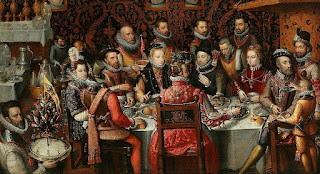
Elizabethan Christmases were literally “the twelve days of Christmas,” culminating in a huge feast on Twelfth Night (January 6). Each day had its own activity—the bringing in of the Yule log on Christmas day; a fox hunt on St. Stephen’s Day, December 26 (where the Queen would ride down the Strand, through Cheapside, and over London Bridge to Greenwich Great Park, among the cheers of the crowds gathered to see her). There were plays, dancing, and feasting every night. When the Thames was deemed solid on December 21, a Frost Fair was set up on the ice, with booths selling food, warm cider, and ribbons, as well as sledding, skating, and games. (This works very well for my Swedish hero, Anton, who attempts to teach the heroine Rosamund to skate!)
But it wasn’t all feasting and games. The Queen kept Christmas at Whitehall that year, and as usual there was a tremendous amount of political skullduggery going on in the palace’s vast corridors. Her Privy Council and chief advisor Lord Burghley still pressed her to marry, and there was no shortage of eager suitors. King Eric XIV of Sweden (who in 1568 would be declared insane and overthrown by his brother) was fighting two wars and needed an influential wife. Elizabeth turned him down when she first came to the throne in 1558, but he tries again. (Anton Gustavson comes to London as part of the diplomatic party from Stockholm. But he has his own agenda in England—and Rosamund Ramsay is a complication he doesn’t need!). The Austrians and French, too, want to try their luck in the marital stakes.
My heroine, Lady Rosamund, lands right in the middle of all this Christmas intrigue! Her parents disapprove of her romantic flirtation with their neighbors’ unreliable son, and hope by sending her to Court as one of the Queen’s Maids of Honor she will be distracted (and find a better match!). There were many levels of service to the Queen for high-born ladies—there were ladies of the Bedchamber (the highest honor), the Privy Chamber, and the Presence Chamber, as well as the six Maids. These were unmarried young ladies, paid 40 pounds a year to walk with the Queen, sit with her, go with her to church, etc. And the Queen did not like for them to have romances. The history of the Elizabethan Court is littered with tales of young women who landed in the Tower for getting caught in dalliances—as Rosamund and Anton know well…
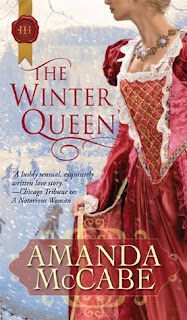
Here are a few great sources I found when researching The Winter Queen:

Janet Arnold, Queen Elizabeth’s Wardrobe Unlock’d and Patterns of Fashion, 1560-1620
Anne Somerset, Elizabeth I and Ladies in Waiting: From the Tudors to the Present Day
Dunlop, The Palaces and Progresses of Elizabeth I
Alan Haynes, Sex in Elizabethan England
Alison Sim, Food and Feast in Tudor England
Maria Hubert, Christmas in Shakespeare’s England
Simon Thurley, Whitehall Palace: The Official Illustrated History
Josephine Ross, The Men Who Would Be King
Figgy Pudding: Chop ½ pound dried figs and mix with ¼ cup bread crumbs. Lightly brown 1 cup of “autumn gathered” walnuts and mix with 1 cup brown sugar, 3 tbsp melted butter, 4 beaten eggs, and spices (1/2 tsp cinnamon, ¼ tsp nutmeg). Bake for at least an hour and serve with cream or “hardsauce” (made from Madeira or malmsey!)
Twelfth Night Cake: In a bowl, combine ½ cup orange juice with 1 cup golden and 1 cup dark raisins and let stand. Cream 1 cup butter, 1 cup sugar, 2 cups wheat flour, and 4 fresh eggs. Add the undrained raisin mixture and a pinch of cinnamon. Stir together and bake until a knife inserted in center comes out clean. Melt 3 tbsp of honey to glaze the cake, decorating with candied cherries. They often add a pea and a bean, so the finder of the bean is king for the evening and the finder of the pea is queen!
Roast Peacock: Take a peacock, break its neck and drain it. Carefully skin it, keeping the skin and feathers together with the head still attached by the skin of the neck. Roast only the bird, with the legs tucked under. When it is roasted enough, take it out and let it cool. Sprinkle cumin on the inside of the skin, then wind it with the feathers and tail around the body. Serve with the tail feathers upright, its neck propped up from within and a lighted taper in the beak. If it is a royal dish, cover the beak with fine gold leaf. Serve with ginger sauce (and lots of pomp and ceremony)
Maids of Honor: Make pastry dough enough for a double-crust pie. Preheat brick over by burning wood or coals inside, then rake them out. Roll out pastry and cut in rounds, then fit in small tartlet tins. Prick pastry with fork tines. Bring to near boil ½ pint cow’s milk with 4 level tbsp white breadcrumbs. Remove from heat and leave for a few minutes. Into that mixture beat 8 tsps butter, cut in cubes, 2 tbsp sugar, grated rind of one lemon, and ¾ cup blanched almonds. Be sure the mixture is not lumpy. Beat in 3 eggs. Half fill the pastry shells and bake for 15 minutes or until mixture is golden brown.